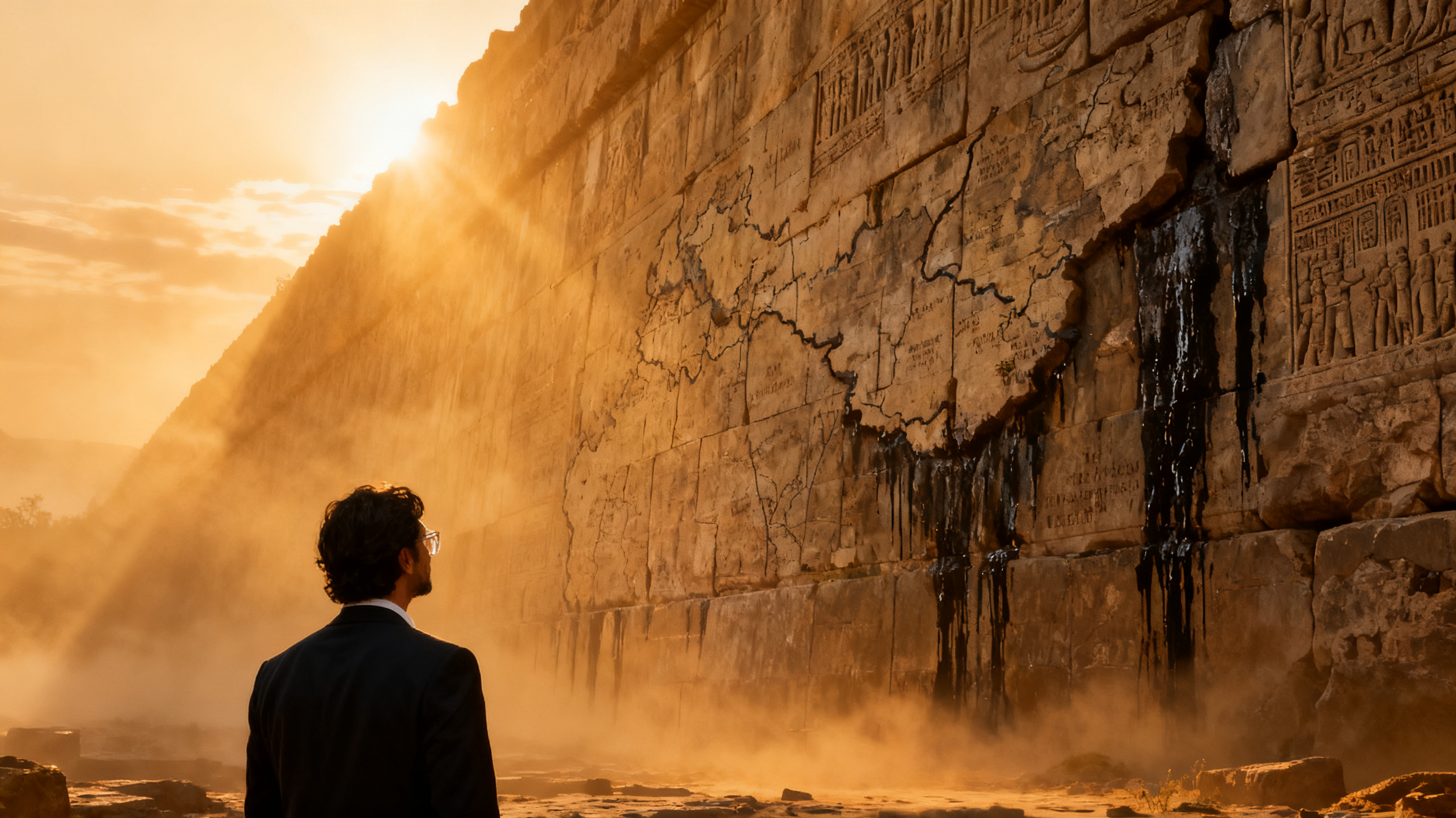
The Material Realities of Empire: How Maps, Bitumen, and Infrastructure Shaped Ancient Power
When Mary I of England died in 1558, she left behind more than a disputed throne and a kingdom torn by religious upheaval. Among her possessions sat a leather-bound atlas—one of only three surviving copies of Battista Agnese’s work—containing 24 hand-painted maps that didn’t just describe the world. They claimed it. This wasn’t decoration for a royal library. This was power made tangible, geography transformed into political ammunition, the known world rendered ownable through ink and vellum.
But Mary wasn’t the first ruler to understand that he who shapes the map shapes reality itself. Four thousand years before her atlas changed hands in Tudor England, Sumerian engineers were mixing bitumen with reeds to waterproof ziggurats, and Roman urban planners were burying their imperial ambitions beneath Barcelona’s streets in precisely laid forum stones. The connection? All three understood what modern nation-states are only now rediscovering: that material infrastructure—maps, roads, public spaces—doesn’t just serve power. It is power.
When Geography Becomes Weaponry
Mary I’s atlas wasn’t a gift of geographical curiosity. It was a claim to legitimacy at a moment when legitimacy was everything. The maps showed Spanish trade routes to the New World, Portuguese dominions in Asia, the known edges of exploitable earth. For a Catholic queen trying to bind England to Habsburg Spain through marriage, these weren’t abstract cartographic achievements—they were the physical proof that her alliance made sense, that her vision connected England to the wealth of empires.
Cartography, in this light, was never neutral. The very act of drawing boundaries, naming seas, marking trade winds—all of it was ideological. Maps determined what was known, and therefore what could be claimed. They made the abstract concrete. When you hold geography in your hands, rendered in gold leaf and careful Latin script, you’re not reading the world—you’re writing who owns it. The fact that this atlas survived, passed from collection to collection for centuries, speaks to its enduring value not as art but as artifact of imperial ambition.
Consider what this means: the most powerful tool of Tudor statecraft wasn’t armies or navies alone, but the ability to represent the world in ways that served English (or Spanish, or Portuguese) interests. Modern geopolitics still operates this way—every border dispute, every maritime claim, every “zone of influence” begins with someone drawing a line and saying “this is real because we say it is.” Mary’s maps were doing the same work.
Engineering the Sacred and Profane
Now step back four millennia to Sumer, where the world’s first urban civilizations faced a different kind of power problem: how do you make mud permanent? How do you build monuments that outlast human memory? The Sumerians solved this with bitumen—natural tar seeps that they learned to harvest, heat, and mix with organic materials to create waterproof mortar.
This wasn’t just construction technique. It was theological engineering. When you waterproof a ziggurat—those massive stepped temples that dominated Mesopotamian cities—you’re making a political statement about divine favor. These structures had to last because they represented the eternal covenant between gods and kings. Bitumen made that possible. It turned mud brick into something approaching permanence, transformed the landscape itself into a monument of power.
The genius wasn’t in discovering bitumen (shepherds had been using it for centuries), but in systematizing its use at scale. Sumerian engineers developed standardized mixtures—bitumen with chopped reeds for flexibility, with sand for strength, with plant resins for adhesion. They created an infrastructure technology that allowed them to build irrigation systems that lasted generations, defensive walls that protected cities, and temples that anchored entire belief systems to specific geographical locations.
This is crucial: infrastructure isn’t neutral. The choice of where to build a canal, how to route a road, which temple gets the best bitumen mortar—all of these are political decisions disguised as technical ones. The Sumerians understood that whoever controls the water controls the city. Whoever builds the temple defines which god (and which king) matters most. Material reality shapes social reality.
The Forum Beneath Your Feet
Fast forward to Roman Barcelona, where archaeologists recently discovered a remarkably preserved forum complex beneath the modern city. Not just a forum—the forum, the beating heart of colonial Roman urbanism, complete with porticos, administrative buildings, and carefully oriented public spaces designed to create Roman citizens out of conquered Iberians.
This is where Mary’s maps and Sumerian bitumen converge in a single insight: empires don’t just conquer territory. They remake it. The Roman forum wasn’t architecture—it was cultural surgery. By creating a public space organized around Roman law, Roman commerce, Roman spectacle, they were literally paving over indigenous reality with imperial infrastructure.
Every forum followed the same template because standardization was the point. Whether you stood in the forum at Rome, Barcelona, or Timgad, you knew where you were in the empire’s hierarchy. The architecture told you. The layout instructed you in how to be Roman—where to gather, how to conduct business, which gods deserved temples, which emperors deserved statues. Infrastructure programmed behavior.
The Barcelona forum, buried for centuries and only now being revealed, shows us something else: infrastructure outlasts politics. The Roman Empire fell. Latin fragmented into Romance languages. But the forum’s stones remained, shaping medieval street patterns, influencing modern urban planning, leaving ghostly imprints of imperial ambition that still direct how people move through space fifteen hundred years later.
The Invisible Hand of the Built Environment
Here’s what connects all three: maps, bitumen, and forums are technologies of consensus reality. They don’t just reflect power—they manufacture it. A map makes colonial claims seem natural by rendering them in clean cartographic lines. Bitumen makes a king’s temple seem eternal by protecting it from flood and time. A forum makes Roman law seem universal by giving it the most prestigious public space in the city.
This matters now because we’re living through our own infrastructure revolution. Every app redesign is urban planning. Every algorithm is a forum, sorting human attention into profitable pathways. Every data visualization is a map, claiming to show reality while actually shaping what we think is real. The tools change but the pattern remains: he who builds the infrastructure writes the culture.
The people walking through Barcelona’s Roman forum didn’t think of themselves as being programmed. They thought they were just going to market, conducting business, participating in civic life. But the space itself was teaching them what normal looked like. The same way highways teach Americans that cars are natural, social media teaches us that constant broadcasting is human, and Google Maps teaches us that the world is legible, ownable, navigable by anyone with a smartphone.
So What?
You live inside someone else’s infrastructure. The streets you walk were laid by urban planners serving particular interests. The apps you use were designed to maximize engagement metrics. The maps you consult were drawn by cartographers who chose what to emphasize and what to omit. None of this is neutral. All of it is political.
The question isn’t whether you’ll be shaped by infrastructure—you will be, we all are. The question is whether you’ll recognize it happening. Mary’s maps, Sumerian bitumen, and Roman forums teach us that power doesn’t just command compliance. It builds the very architecture of possibility, making certain choices seem natural and others impossible to imagine.
This is why every generation must ask: what infrastructure are we building? Who does it serve? What behaviors does it encode? What worldview does it assume and reinforce? The Sumerians built temples that made kings seem eternal. The Romans built forums that made empire seem civilized. The Tudors collected maps that made colonization seem inevitable.
What are we building? And whose reality will it serve?
Take Home Points
- Infrastructure is never neutral—every map, road, public space, or platform encodes political and ideological choices that shape human behavior and belief
- Material permanence creates legitimacy—from bitumen-sealed ziggurats to marble forums, rulers understand that durable physical infrastructure makes power seem natural and eternal
- Cartography is claim-making—maps don’t just describe territory, they assert ownership and make colonial ambitions appear as geographical fact
- Standardization is control—whether Roman forums or social media platforms, identical infrastructure across vast distances creates conformity disguised as choice
- Today’s digital infrastructure operates on ancient principles—apps, algorithms, and data systems are doing the same work as Mary’s maps and Roman forums, shaping consensus reality for commercial and political ends
- Awareness is resistance—recognizing how built and digital environments program behavior is the first step toward building infrastructure that serves human flourishing rather than extracting it
Sources:
- “A Collection of Maps Owned by England’s First Queen Spent Centuries Overlooked in a Family Library. Now the Rare Volume Is on Sale for $16 Million” - Smithsonian Magazine (https://www.smithsonianmag.com/history/a-collection-of-maps-owned-by-englands-first-queen-spent-centuries-overlooked-in-a-family-library-now-the-rare-volume-is-on-sale-for-16-million-180988604/)
- “Sumerian Bitumen: Ancient Engineers’ Secret to Monumental Construction” - Ancient Origins (https://www.ancient-origins.net/news-history-archaeology/sumerian-bitumen-00102535)
- “Roman Forum Barcelona: Major Archaeological Discovery Reveals Ancient City Center” - Ancient Origins (https://www.ancient-origins.net/news-history-archaeology/roman-forum-barcelona-00102582)