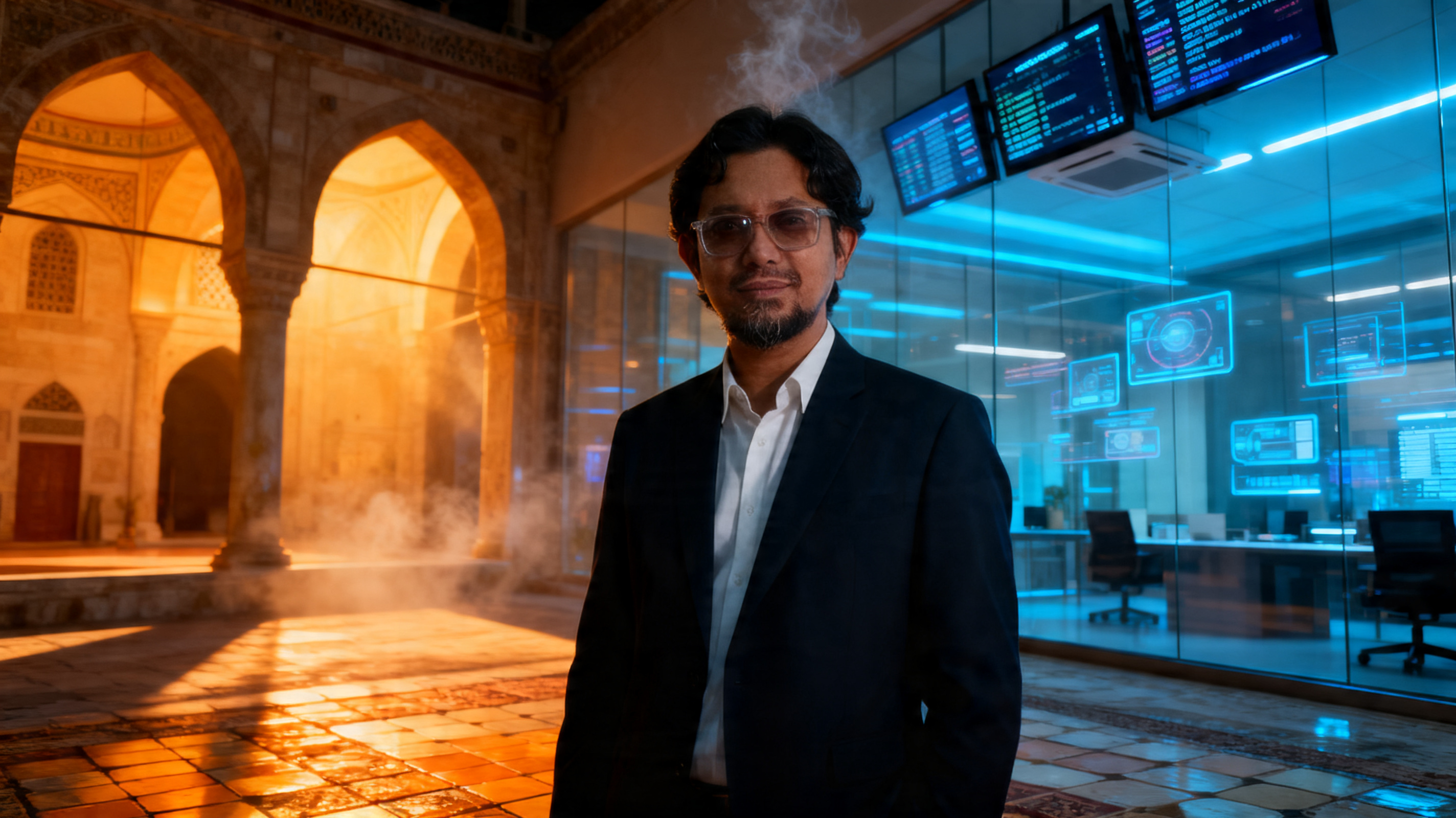
The Sacred and The Silicon: When Muslim Communities Outsource Purpose to Tech Capital
There’s a peculiar ritual happening in Muslim conferences these days. A founder takes the stage—beard trimmed just right, hoodie under a blazer—and delivers what sounds like a TechCrunch pitch: “We’re building the super app for the ummah. Think Uber meets Islamic education. We’ve got 50K MAUs, raised a pre-seed, and we’re optimizing for conversion.” The audience claps. Someone tweets it with a fire emoji. And somewhere, a mosque down the street sits empty on a Tuesday night, its imam wondering why the youth won’t come for anything except Eid.
We’ve traded the sacred for the scalable. And we’re calling it progress.
The same venture capital logic that turned startups into slot machines—optimized for dopamine hits and quarterly growth—is now reshaping how we think about faith itself. Mosques are rebranding as “community hubs.” Islamic education is “content.” Spiritual growth is a “user journey.” We’ve adopted Silicon Valley’s entire vocabulary, and with it, its values. The question isn’t whether tech can serve Islam—of course it can. The question is whether we’ve let tech capital define what Islam should serve.
The Metrics of Meaning
In 2010, if you wanted to measure a mosque’s impact, you’d look at how many lives it changed. Today, you count app downloads.
This shift didn’t happen in a vacuum. The past decade saw an explosion of Muslim venture capital—funds with “halal” in their pitch decks, accelerators promising to “empower Muslim founders,” conferences where Islamic finance panels sit next to SaaS startup workshops. The stated goal is noble: Muslims building wealth, creating jobs, serving the ummah through innovation. The unstated consequence is darker: we’ve begun measuring spiritual institutions by investor metrics.
Walk into a Muslim nonprofit board meeting now. They’re not asking “Are we cultivating taqwa?” They’re asking “What’s our donor acquisition cost?” They don’t discuss whether their programs transform character—they track NPS scores. The language of the spreadsheet has colonized the language of the soul.
And here’s the uncomfortable truth: it works. By Silicon Valley’s standards, it works brilliantly. Muslim apps have millions of users. Islamic crowdfunding platforms move tens of millions in capital. We can A/B test Quran recitation features and optimize dhikr reminders for engagement. We have the data. We have the scale. What we’re losing is the why.
Because venture capital doesn’t care about transformation—it cares about transaction volume. It doesn’t measure depth; it measures reach. And when mosques adopt this logic, they become what tech would call them: distribution channels. Places to acquire users for the app, donors for the fund, attendees for the conference. The spiritual becomes instrumental. The sacred becomes a stepping stone to something supposedly larger—which is always, always about scale.
When the Masjid Becomes a Minimum Viable Product
The conversation about “modernizing mosques” carries a particular irony. We’re told mosques need to become “relevant” again—offer yoga classes, coffee shops, coworking spaces, youth sports leagues. Anything to get people through the door. The assumption is that the traditional mosque—a place for prayer, knowledge, spiritual retreat—has failed. It’s a relic. We need to iterate.
This is startup thinking applied to sacred space. The mosque is the product. If people aren’t using it, the product has failed to find product-market fit. So we pivot. We optimize. We survey the “target demographic” and redesign the “user experience.”
But what if the mosque isn’t the problem? What if we are?
In Surah Al-Jumu’ah, Allah commands the believers to leave their trade when the call to prayer sounds and hasten to the remembrance of Allah. Not to a community hub. Not to a networking event. To dhikr—the remembrance that reorients the soul. The mosque’s purpose isn’t to compete with the world for your attention. Its purpose is to offer you something the world cannot give: stillness in the presence of the Divine.
Yet we’ve convinced ourselves that stillness doesn’t scale.
So we add features. We host interfaith BBQs and financial literacy workshops. We put TVs in the lobby and call it “welcoming.” None of this is inherently wrong—community matters, practical knowledge matters. But when these additions become the draw, when people come for the coffee and leave before Maghrib, we’ve built something that looks like a mosque but functions like a rec center with prayer mats.
And the venture mindset loves it. Because it’s measurable. You can track attendance, count workshops, report engagement. You can show growth. You can pitch it to donors as “impact.” What you can’t measure is whether a single heart broke open in sajdah last Thursday. Whether someone left Fajr different than they arrived. Whether the mosque is still doing what it was built to do: be a place where Heaven touches Earth.
The Generation That Forgot What Capital Is For
The Prophet ﷺ built a market in Madinah—not to celebrate commerce, but to regulate it. To ensure it served justice, dignity, community welfare. Trade was a tool. The ummah was the purpose.
We’ve reversed the equation. The ummah has become a market. The believers are “stakeholders.” Our gatherings are “opportunities for synergy.” And the most grotesque part? We say this with pride, as if turning faith into a fundraising vertical is a sign of sophistication.
There’s a reason Surah Al-Fath 48:29 describes the companions as “ruthless against the disbelievers, merciful among themselves.” They knew the difference between sacred bonds and strategic partnerships. They understood that not everything valuable can be valued in capital. That some relationships exist outside the ledger.
We don’t. Or we’ve forgotten.
So when a Muslim tech founder says, “I’m building this to serve the ummah,” ask the next question: How will you know if you’ve succeeded? If the answer involves monthly recurring revenue, you’re not serving the ummah. You’re serving investors. And that’s not automatically evil—but call it what it is. Don’t sanctify the cap table.
And when a mosque says, “We need to be a community hub to stay relevant,” ask: Relevant to whom? To Allah, or to the grant committee? To the believer seeking refuge from the noise, or to the strategic plan that needs butts in seats?
What We Owe the Next Generation
The youth aren’t leaving mosques because mosques lack amenities. They’re leaving because we’ve taught them that everything—even worship—is transactional. You come to mosque to get something: blessings, networking, a good marriage prospect, a line on the resume. We’ve made faith instrumental, a means to worldly ends. And then we wonder why they find the world more honest about what it offers.
The answer isn’t better marketing. It’s transformation. Real transformation. The kind that Silicon Valley can’t package. The kind that happens when a human being encounters the infinite and comes away changed. When prayer isn’t a box to check, but a conversation that unsettles and rebuilds you. When the mosque isn’t a product, but a sanctuary—a place set apart precisely because it refuses to compete on the world’s terms.
This is the work. Not optimizing for scale. Not disrupting traditional models. But holding space for the sacred in an age that wants to monetize everything. Teaching a generation that not all value is captured by venture capital. That some things grow slowly, quietly, immeasurably—and those things might be the only things worth growing at all.
Take Home Points
-
The language you use shapes the reality you build. When we talk about mosques using startup terminology (user acquisition, engagement metrics, product-market fit), we subtly redefine their purpose from spiritual transformation to consumer satisfaction.
-
Venture capital rewards scale, not depth. The metrics that make a startup successful (growth rate, user numbers, funding rounds) are fundamentally incompatible with the metrics of spiritual development (sincerity, transformation, devotion). We must resist letting investor logic define religious success.
-
Not everything valuable can be measured. The most important work of a mosque—breaking hearts open in prayer, providing sanctuary from the world, facilitating encounter with the Divine—produces no data points. If we only value what we can count, we will lose what truly counts.
-
The ummah is not a market. Community bonds are not strategic partnerships. Fellow believers are not stakeholders. Sacred relationships exist outside economic logic, and must be protected from it.
-
Transformation requires space set apart. The mosque’s power comes precisely from not competing with the world on the world’s terms. When we make mosques indistinguishable from community centers, we rob the ummah of the one place that offers something radically different.
Sources:
- Muslim Capitalism and the Rise of Tech and VC Culture - Muslim Matters
- Mosques’ Role in the 21st Century - About Islam