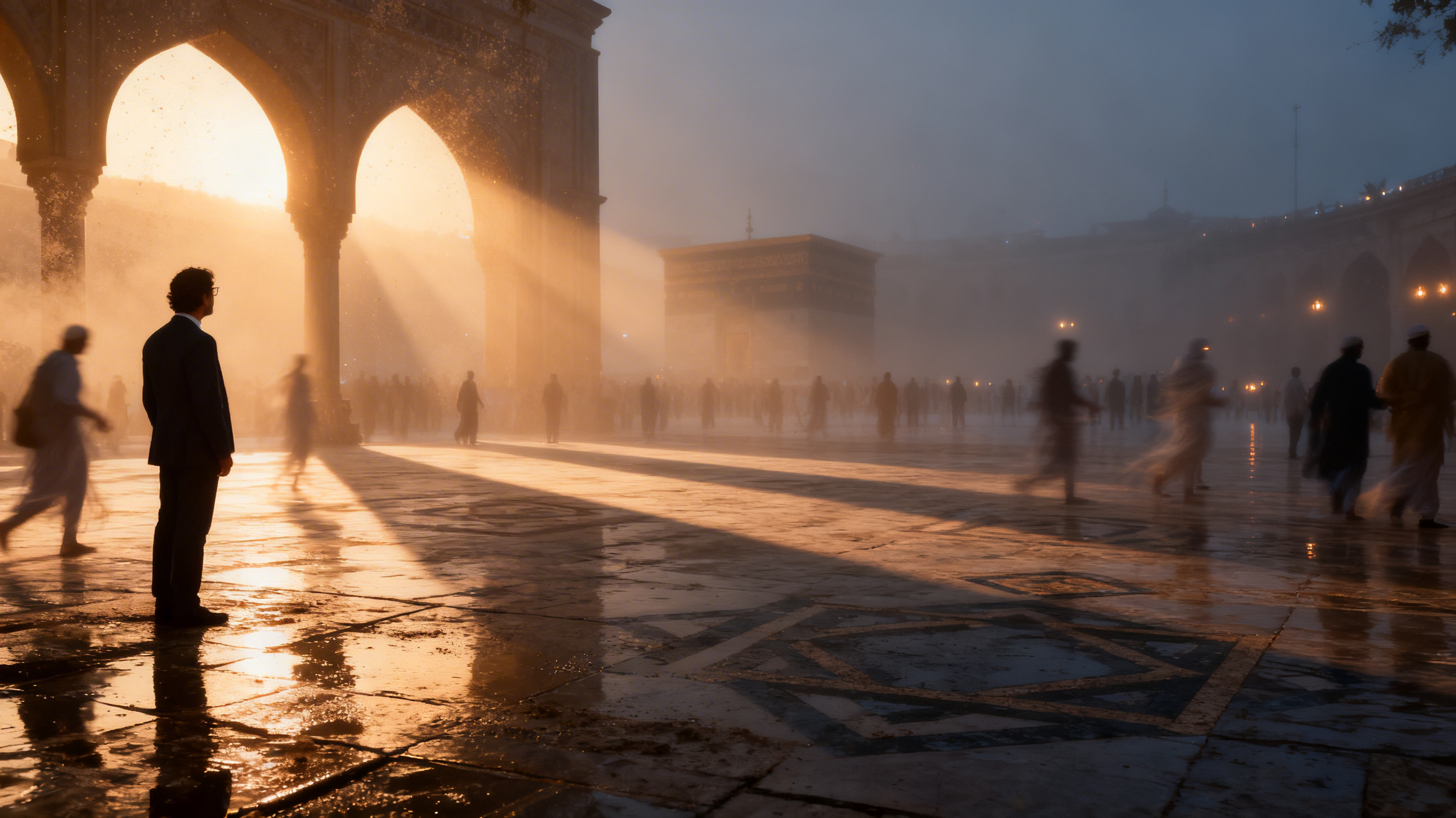
When Faith Becomes Spectacle: What We Lose When We Reduce Sacred Sites to Trivia
Did you know the Great Mosque of Makkah has 210 doors? That the Kaaba’s black stone was once white? That there are five minarets instead of the usual four? If you’ve scrolled through Islamic content recently, you’ve probably seen these facts packaged into neat listicles, often with the breathless framing: “15 Things You Didn’t Know About Makkah!”
Here’s what troubles me: I did know some of these things. And the ones I didn’t know left me feeling… nothing. Not wonder. Not reverence. Just the mild satisfaction of collecting information I might deploy at a future dinner conversation. When did the House of Allah become trivia night material?
The shift is subtle but profound. We’ve moved from pilgrimage to tourism, from contemplation to consumption, from sacred encounter to content strategy. And in that movement, something essential is being lost—not just about Makkah, but about how we relate to the entire inheritance of our faith.
From Presence to Performance
Our ancestors approached Makkah with trepidation and longing. They saved for decades. They risked their lives crossing deserts. They wrote poetry about the moment they would first glimpse the Kaaba, that geometric miracle of orientation around which the entire Muslim world physically turns five times daily. The journey to Makkah was as spiritually significant as arriving at Makkah.
Today, we’ve Instagram-ified the sacred. Before the pilgrim’s foot touches the marble, the phone is out, capturing the “perfect shot” for social proof. The same technology that could deepen our connection—allowing us to study Quranic recitation, understand prophetic history, connect with scholars—has instead become a screen between us and the sacred. We see the Kaaba through a lens before we see it with our hearts.
The three-part “15 Things You Didn’t Know” series represents something larger than a well-intentioned educational effort. It represents the colonization of sacred space by the logic of content marketing. Facts become list items. Architectural marvels become “unknown trivia.” Spiritual geography becomes quiz material. The sacred is repackaged as the surprising, because surprise drives engagement, and engagement drives metrics.
But Makkah was never meant to surprise you. It was meant to transform you.
The Secularization of the Sacred
There’s a Western academic tradition of studying religious sites through purely historical, architectural, or anthropological lenses—valuable work, but work that deliberately brackets questions of meaning, truth, and spiritual encounter. What we’re witnessing now is different: Muslims ourselves adopting this sanitized, fact-oriented approach to our own holy sites.
When we reduce the Kaaba to its measurements, the Zamzam well to its geological properties, the Black Stone to its meteorite origins, we’re inadvertently secularizing what Allah designated as sacred. We’re saying: “Look how interesting this is!” when we should be saying: “Look what this means.”
The difference matters. Interest is consumer-oriented. Meaning is transformation-oriented. One scrolls. The other kneels.
Consider how the Quran itself speaks of Makkah. It doesn’t give you a walking tour. It doesn’t itemize architectural features. It speaks of Ibrahim’s supplication while raising the foundations. It speaks of the valley without vegetation that became a sanctuary. It speaks of the first house established for humanity, blessed and a guidance for the worlds. Every verse is drenched in purpose, in covenant, in the weight of divine selection.
When we strip away that weight and serve up “interesting facts,” we’re not making the sacred accessible—we’re making it mundane.
What Happens to Knowledge Without Khushu’
There’s nothing wrong with knowledge. The Prophet ﷺ sought refuge from knowledge that doesn’t benefit, which implies that beneficial knowledge exists and should be pursued. Understanding the historical development of the Haram, the engineering feat of its expansion, the wisdom in its architectural design—this can all deepen appreciation.
But knowledge pursued as collection, as entertainment, as social currency, becomes spiritually inert. You can memorize fifty facts about Makkah and still circle the Kaaba with a distracted heart. You can know the history of every minaret and still miss the entire point of why the adhan is called from those heights.
This is the crisis of the modern Muslim intellectual class—we’re information-rich and transformation-poor. We know about things without being changed by things. We study our heritage the way a museum curator studies artifacts: with expertise but without submission.
The classical Islamic tradition understood that knowledge of sacred things required a sacred approach. You didn’t just learn about Makkah—you prepared yourself spiritually to even speak about it. The adab, the reverence, the weight of discussing what Allah Himself has made inviolable—this created a completely different relationship with information.
Tourism vs. Pilgrimage: A Generational Question
Here’s the uncomfortable truth: many of us approach Hajj more like tourists than pilgrims. We plan itineraries. We compare hotel packages. We create content. We tick boxes. The sacred becomes a destination on a spiritual bucket list, and the rites become photo opportunities.
This isn’t entirely our fault. The entire infrastructure now caters to this mentality. Luxury hotels tower over the Haram. Shopping malls compete with prayer spaces. The rituals of millions are managed with the efficiency of an airport terminal. We’re not wrong for being shaped by this environment—but we are responsible for recognizing what’s being lost and fighting to reclaim it.
The generation that Surah Al-Fath describes—“Muhammad is the Messenger of Allah; and those with him are forceful against the disbelievers, merciful among themselves. You see them bowing and prostrating”—this wasn’t a generation of trivia collectors. They were a generation transformed by proximity to the sacred, to prophetic presence, to divine command.
If we reduce our engagement with sacred sites to listicle consumption, what generation are we building? One that knows about the faith but isn’t shaped by the faith. One that can pass a quiz but can’t access transformation.
So What?
This isn’t a call to abandon knowledge or stop sharing information about Islamic heritage. It’s a call to examine how we approach that knowledge and what purpose it serves.
Before you share that next “amazing facts” post about Makkah or Madinah, ask yourself: Does this deepen reverence or just collect engagement? Does it point toward the sacred or reduce it to the interesting? Will this help someone stand before the Kaaba with greater khushu’, or just give them conversation material?
The test isn’t whether information is accurate—it’s whether it serves the purpose for which these sites exist. Makkah isn’t there to fascinate you. It’s there to orient you. Not geographically—spiritually. Every fact about it should draw you closer to that orientation, not distract you with trivia.
We can know everything about the Kaaba’s dimensions and nothing about why our hearts break when we see it. We can memorize the history of every expansion and miss the point that it keeps expanding because this ummah keeps growing, because the promise of Ibrahim is still unfolding, because Allah is still gathering His servants to this house.
Choose knowledge that bends you in sajdah, not knowledge that makes you nod in acknowledgment.
Take Home Points
-
Sacred knowledge requires sacred approach — Facts about holy sites should deepen reverence, not just satisfy curiosity. If your learning doesn’t increase your khushu’, question its purpose.
-
Consumption isn’t connection — Collecting information about Makkah isn’t the same as being transformed by Makkah. Don’t confuse scrolling through content with spiritual growth.
-
Tourism vs. pilgrimage is a heart issue — The difference isn’t just logistical—it’s spiritual. Approach sacred sites seeking transformation, not just experience.
-
Content culture secularizes the sacred — When we package holy sites as “interesting facts,” we inadvertently strip them of the weight Allah gave them. Resist the reduction.
-
Build a generation of depth, not trivia — The sahaba weren’t distinguished by how much they knew about the faith, but by how deeply it shaped them. Prioritize transformation over information collection.
Sources:
- “15 Things You Didn’t Know About Makkah – Part 1” — Muslim Matters (https://muslimmatters.org/2026/03/22/15-things-you-didnt-know-about-makkah-part1/)
- “15 Things You Didn’t Know About Makkah – Part 2” — Muslim Matters (https://muslimmatters.org/2026/03/29/15-things-you-didnt-know-about-makkah-part2/)
- “15 Things You Didn’t Know About Makkah – Part 3” — Muslim Matters (https://muslimmatters.org/2026/04/07/15-things-you-didnt-know-about-makkah-part3/)