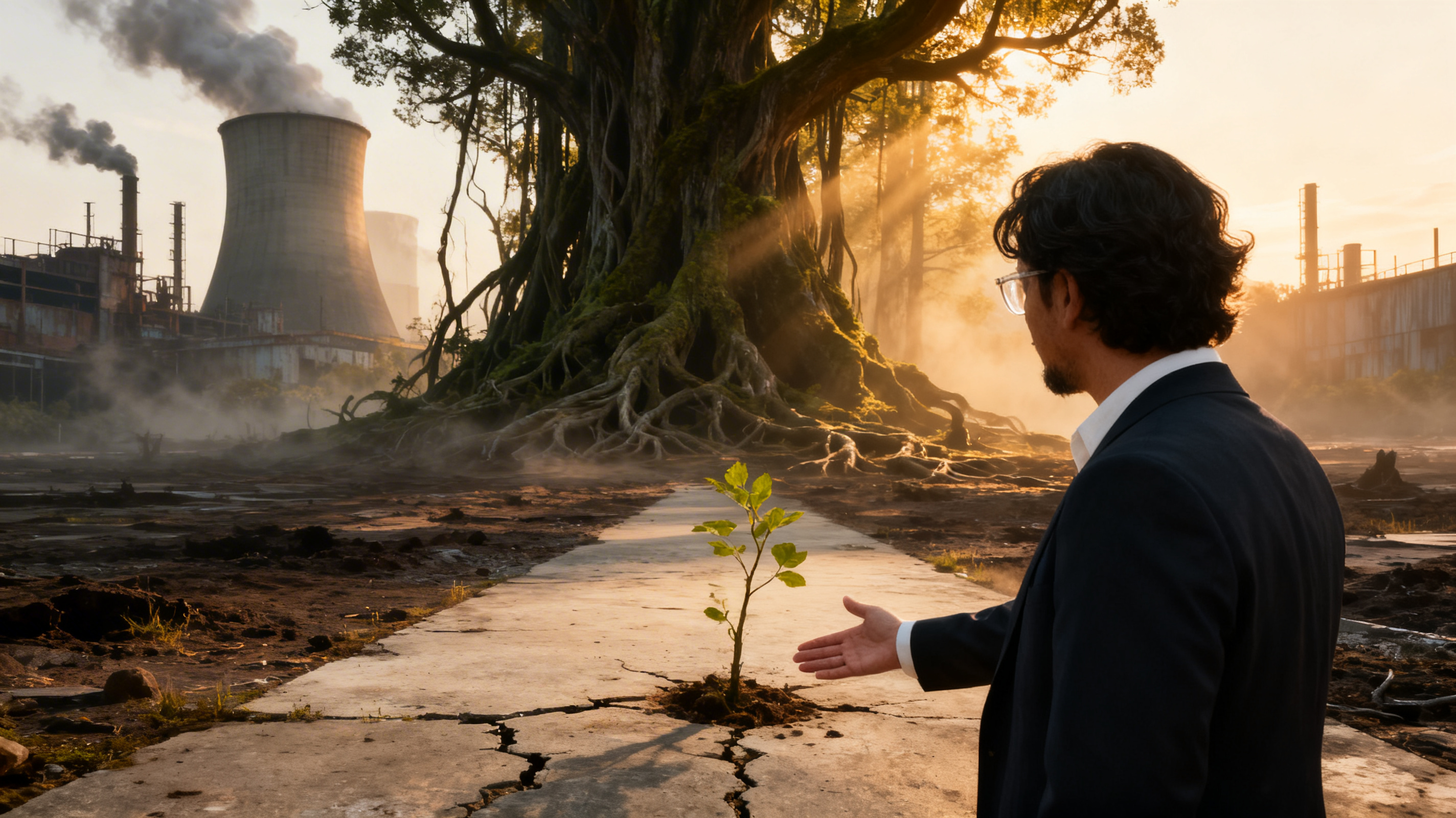
The Environmental Covenant: Why Islamic Ecology Offers a Radical Alternative to Western Climate Politics
Here’s what bothers me about modern climate activism: we’ve turned the planet into a negotiation. Carbon credits traded like stocks. Emissions caps calculated by economists. Nature reduced to “ecosystem services” — as if a forest’s value depends on what humans can extract from it. We fight climate change with the same mindset that caused it: everything has a price, everything can be managed, everything bends to human will.
But there’s another way — older, deeper, and largely ignored in global climate discourse. It doesn’t start with spreadsheets or summits. It starts with a simple, terrifying question: What if the earth doesn’t belong to us at all?
The Missing Voice at the Climate Table
When world leaders gather for climate conferences, religious voices are barely audible. Sure, there’s the occasional interfaith panel or papal encyclical mentioned in passing. But the serious work — policy, finance, technology — that’s left to governments, corporations, and NGOs operating within secular frameworks.
Islam holds roughly 1.8 billion adherents, many in regions already devastated by climate impacts. Yet Islamic environmental ethics remain peripheral to mainstream climate discourse. The Green Hadiths — prophetic traditions explicitly addressing environmental stewardship — are virtually unknown outside Muslim communities. Why?
Partly, it’s the legacy of colonialism’s intellectual partitions: religion over here, science and governance over there. Partly, it’s Islam’s own fragmentation, where environmental fiqh (jurisprudence) hasn’t been systematized for modern crises. But mostly, it’s because Islamic ecology offers something the current system cannot absorb: a complete rejection of nature as property.
Khalifah: The Steward Who Owns Nothing
In Surah Al-Baqarah (2:30), Allah announces to the angels His intention to place a khalifah (steward/vicegerent) on earth. Not an owner. Not a conqueror. A steward — someone entrusted with something precious belonging to another.
This distinction isn’t semantic gymnastics. It’s foundational. The dominant Western paradigm, rooted in Enlightenment thought and industrial capitalism, treats nature as resource pool awaiting human ingenuity. Even conservation movements speak of “managing” wilderness, “preserving” ecosystems — language that assumes human authority over natural systems.
Islamic ecology begins from the opposite premise: you own nothing. The earth, its creatures, its water and soil — all belong to Allah. Humans are merely temporary residents, accountable for every seed planted and every tree felled. This accountability isn’t legal or economic. It’s theological. Divine.
The Prophet Muhammad (peace be upon him) said: “If the Hour (the Day of Judgment) is about to be established and one of you is holding a palm shoot, let him take advantage of even one second before the Hour is established to plant it” (Musnad Ahmad). Think about that instruction. The world is ending. Nothing you plant will benefit you. Plant it anyway. Not for profit. Not for carbon offsets. Because stewardship doesn’t end when incentives disappear.
The Green Hadiths: Ecology as Worship
The ten Green Hadiths reveal an environmental ethic woven into daily practice, not relegated to special occasions. Animals have rights — the Prophet prohibited using them as targets for sport, overloading them, or neglecting their care. He condemned killing frogs (whose croaking is a form of tasbih, glorification of God) and cutting down trees without need.
Water conservation isn’t about scarcity economics; it’s about respecting Allah’s creation. The Prophet admonished even a companion performing ablution beside a flowing river: “Do not waste water even if you are at a flowing river.”
What’s radical here is the integration. Environmental care isn’t a separate “green initiative” tacked onto religious life. It’s inseparable from worship itself. The same hadith that instructs prayer also warns against harming creation. There’s no compartmentalization — no “spiritual life” versus “practical ecology.”
Compare this to secular climate activism, where environmental action requires convincing people through fear (disaster scenarios), guilt (carbon footprints), or incentives (green jobs, tax breaks). Islamic ecology starts from taqwa (God-consciousness): you protect creation because Allah sees, because you’ll answer for it, because every leaf recognizes its Creator even if you forget yours.
Why This Hasn’t Scaled
If Islamic environmental ethics are so robust, why haven’t they shaped global climate policy? Three reasons:
First, Muslims stopped implementing them. Ottoman forestry laws and Mughal water management systems once reflected these principles, but colonialism disrupted indigenous governance, and post-colonial Muslim states adopted Western development models wholesale. Oil wealth particularly poisoned the well — Gulf nations became carbon-economy enablers while Islamic environmental law gathered dust.
Second, the discourse got trapped in reactivity. Muslim environmentalists spent energy defending Islam against accusations of backwardness rather than proactively building institutions. Meanwhile, secular frameworks filled the vacuum, setting terms Muslims now struggle to challenge.
Third, implementation requires spiritual infrastructure the modern ummah lacks. Islamic ecology isn’t a policy you legislate; it’s a consciousness you cultivate through education, community practice, and moral formation. When Muslims themselves treat mosques as ritual spaces divorced from daily ethics, how can khalifah stewardship scale?
The Practical Path Forward
But here’s where it gets interesting: Islamic ecology doesn’t require global adoption to prove transformative. It needs networks of believers actually living it.
Imagine mosques with mandatory green audits — not for PR, but as part of governance. Waqf (endowment) lands managed as permanent conservation trusts, forbidden from development regardless of market value. Islamic finance refusing investments in extractive industries not because they’re unprofitable, but because they violate the khalifah covenant. Halal certification expanding beyond food to include ethical sourcing and environmental impact.
This isn’t hypothetical. Indonesia’s fatwa against wildlife trafficking, Morocco’s solar energy investments framed through Islamic ethics, grassroots groups in Pakistan planting millions of trees as sadaqah jariyah (continuous charity) — these scattered efforts prove the framework works when implemented sincerely.
The question isn’t whether Islamic ecology can solve climate change alone. It’s whether it offers what secular activism desperately lacks: a moral foundation that doesn’t collapse when economics shift or politics change. A reason to care for creation that outlasts self-interest.
So What?
Whether you’re Muslim or not, this matters. Because the climate crisis is fundamentally a crisis of relationship — between humans and nature, present and future, desire and responsibility. Carbon markets address symptoms. Technology offers tools. But neither changes the underlying disease: the belief that nature exists for human exploitation.
Islamic ecology proposes that humans exist for something beyond ourselves — that our purpose includes, but isn’t limited to, our own flourishing. That we’re accountable to something higher than quarterly profits or election cycles.
This terrifies modern systems built on autonomy and growth. It should. Because it suggests limits we don’t get to set, obligations we can’t negotiate away, and an authority we can’t vote out of existence.
The real question isn’t whether Islamic environmental ethics can influence the UN. It’s whether they can still shape Muslims themselves — and whether that internal transformation might ripple outward in ways policy summits never will.
Take Home Points
- Khalifah stewardship reframes humans as trustees, not owners — fundamentally challenging property-based environmental paradigms
- Islamic ecology integrates worship and practice — environmental care isn’t a separate initiative but woven into daily religious life
- The Green Hadiths offer concrete guidance on animal rights, water conservation, and plant protection rooted in divine accountability, not economic incentive
- Implementation requires spiritual infrastructure — mosques, waqf institutions, and Islamic finance must operationalize these ethics, not just reference them
- Transformation starts locally — Muslim communities living khalifah principles create models that challenge secular climate frameworks regardless of policy adoption
- The crisis is relational, not just technical — no amount of technology solves the problem if humans still view nature as resource rather than sacred trust
Sources:
- “10 Green Hadiths” - AboutIslam.net (https://aboutislam.net/shariah/hadith/hadith-collections/10-green-hadiths/)